
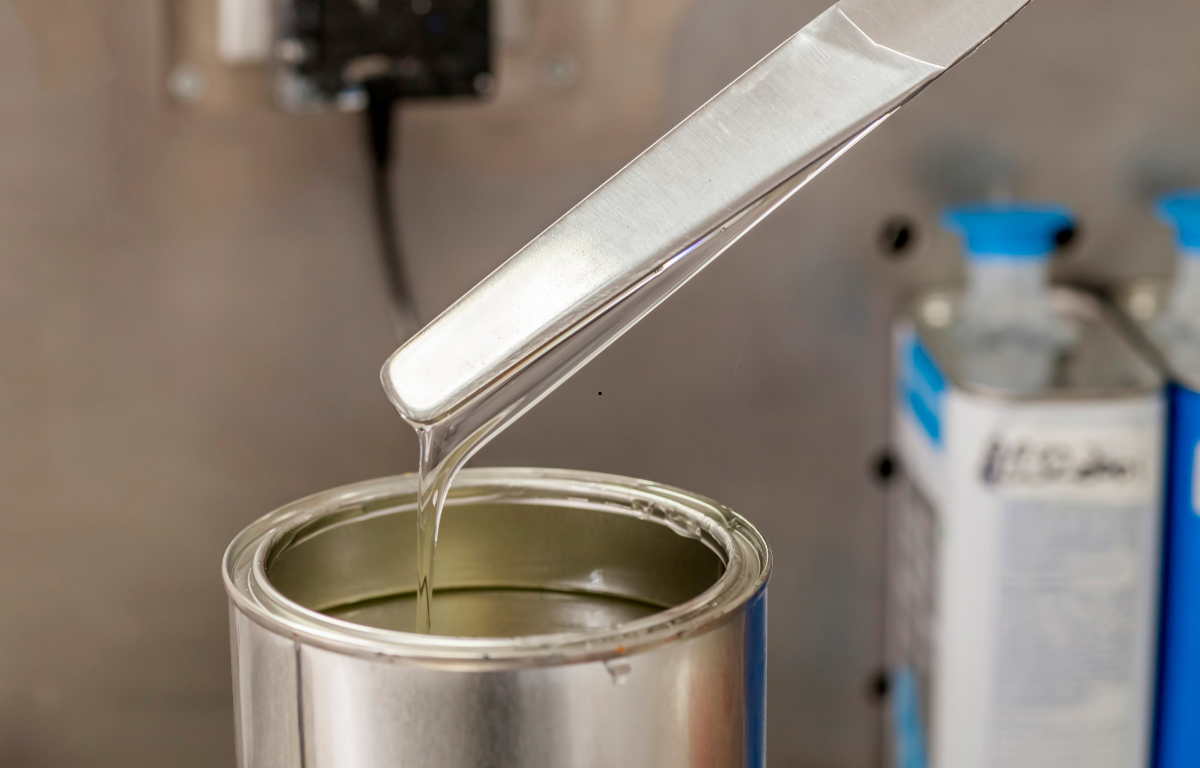
Specify the wrong acrylic resin and you find out eighteen months later, when the coating on a client’s façade has chalked, the gloss has dropped, and nobody wants to pay for the recoat. Specify the right one and the film is still holding colour after a decade of sun. The gap between those two outcomes is rarely price. It is grade selection: monomer chemistry, glass transition temperature, carrier system, and whether the supplier could actually prove any of it.
This guide is written for the people who have to make that call — formulators, coating chemists, procurement managers, and engineers sourcing resin for the first time. You will get a plain explanation of what acrylic resin is, how it is manufactured, how the types differ, which properties on a technical data sheet actually predict field performance, how acrylic compares with epoxy, polyester and polyurethane, what drives price in 2026, and what safety and regulatory paperwork a credible supplier hands over without being asked twice.
The market context, for scale: MarketsandMarkets valued the global acrylic resins market at roughly USD 20.75 billion in 2024, with growth running near 6.5% a year through 2030.
What Is Acrylic Resin?
Acrylic resin is a synthetic polymer built by linking acrylate and methacrylate monomers — most often methyl methacrylate (MMA), butyl acrylate, and 2-ethylhexyl acrylate — into long chains through free-radical polymerization. The resulting material is clear, light, hard-wearing, and unusually resistant to ultraviolet light, which is the single trait that keeps it in outdoor coatings decade after decade.
Think of the monomer mix as a recipe with dials. Raise the proportion of hard monomers such as MMA and the film gets rigid, glossy and block-resistant. Raise the soft monomers such as butyl acrylate and it gets flexible enough to move with a substrate through a temperature cycle. Nothing else about the resin family explains its reach better than this: the same chemistry serves a dental prosthesis, an aquarium panel, and a bridge coating because the formulator is not choosing “acrylic” so much as choosing a specific point on that dial.
For the fundamentals in longer form, our companion piece on what are acrylic resins and how are they used covers the basics without the procurement detail.
Thermoplastic vs. Thermosetting Acrylic Resin
Two families sit under the same name and behave nothing alike under heat.
Thermoplastic acrylic resin keeps its polymer chains separate. Heat it and it softens; cool it and it hardens again, and you can repeat the cycle. Sign faces, cast sheet, and reworkable industrial finishes rely on that reversibility. See our breakdown of thermoplastic acrylic resins for processing detail.
Thermosetting acrylic resin carries reactive groups — usually hydroxyl — that cross-link during cure, often with an isocyanate or melamine hardener. Once that network forms, it is permanent. The film will not remelt, resists solvent wipe, and holds up under chemical attack. Automotive clearcoats and heavy-duty industrial finishes sit here.
How Acrylic Resin Is Made
Production starts upstream of the resin plant, with propylene oxidised to acrylic acid and esterified into acrylates, and with MMA produced by the acetone-cyanohydrin route or newer C2/C4 processes. Those monomers arrive at the resin producer, and the polymerization method chosen there determines what the customer can actually do with the product.
- Emulsion polymerization — monomers are dispersed in water with surfactants and a water-soluble initiator. Output is an acrylic polymer emulsion, the backbone of architectural paint.
- Solution polymerization — monomers react in an organic solvent. Output is a solvent-borne resin with tightly controlled molecular weight, favoured for industrial and automotive coatings.
- Suspension polymerization — monomer droplets polymerise into beads, later moulded or dissolved. Dental and moulding grades come from here.
- Bulk (mass) polymerization — monomer polymerises with almost nothing else present, producing cast PMMA (polymethyl methacrylate) sheet with optical clarity.
Chain length, branching, and cross-link density are set during this stage, and they are effectively locked in by the time the drum reaches your plant. The polymer chemistry behind these choices is covered in more depth in our guide to acrylic resin chemistry.
Types of Acrylic Resin: A Side-by-Side Comparison
Table 1. Acrylic resin types, forms, and typical applications.
| Type | Typical Form | Cure Behaviour | Best Suited To |
|---|---|---|---|
| Thermoplastic acrylic | Solution, granule, sheet | Physical drying, re-meltable | Signage, road marking, lacquers, reworkable parts |
| Thermosetting (hydroxyl) acrylic | Solution or waterborne | Cross-links with isocyanate/melamine | Automotive clearcoat, industrial 2K finishes |
| Acrylic emulsion (waterborne) | Liquid dispersion | Coalescence on water loss | Architectural paint, low-VOC content systems |
| Solvent-based acrylic | Liquid solution | Solvent evaporation or cure | Fast-cure industrial coatings, metal primers |
| Acrylic powder / solid grade | Powder, flake, bead | Melt then cross-link | Powder coatings, textile and leather finishing |
| Cast PMMA | Sheet, block, rod | Already polymerised | Glazing, displays, aquaria, dental appliances |
| UV-curable acrylate oligomer | Liquid | Photo-initiated cure in seconds | Wood, plastic, electronics; see UV curable coatings |
The Properties That Actually Predict Performance
Most buyers read the marketing page. The technical data sheet is where the decision lives. Five numbers on it do most of the work.
Glass transition temperature (Tg) tells you where the film moves from glassy to rubbery. High Tg gives hardness and block resistance; low Tg gives flexibility and better low-temperature film formation. Pick the wrong end and your coating either cracks in winter or blocks in a warehouse in June.
Minimum film formation temperature (MFFT) matters for waterborne systems: apply below it and the particles never coalesce into a continuous film, however good the resin is on paper.
Acid value and hydroxyl value tell you how the resin will react — the hydroxyl number effectively sets the stoichiometry for the isocyanate hardener in a 2K system. Molecular weight governs viscosity, solids at application, and toughness. And the solids content decides how much resin you are actually buying per kilogram of drum.
Table 2. Data-sheet parameters and what each one controls.
| Parameter | What It Controls | Typical Buyer Question |
|---|---|---|
| Glass transition temp (Tg) | Hardness, flexibility, block resistance | Will the film crack or block at service temperature? |
| MFFT | Film formation of waterborne grades | Can this be applied in cold-season conditions? |
| Hydroxyl value | Cross-link density in 2K systems | How much hardener per 100 parts resin? |
| Acid value | Water dispersibility, pigment wetting | Will it stabilise my pigment package? |
| Molecular weight | Viscosity, solids, toughness | Can I hit the spray viscosity at high solids? |
| Solids content (%) | Cost per kg of applied film | What am I paying for that isn’t solvent or water? |
Where Acrylic Resin Is Used Across Industry
Paints and Coatings
Coatings remain the largest single outlet, and it is not close — the paints and coatings segment takes roughly 60% of global acrylic resin volume. The draw is UV resistance paired with gloss and colour retention, which is why exterior masonry paint, coil coating, and road marking all lean acrylic. Our overview of acrylic resins for coatings goes deeper on surface protection, and acrylic coatings weatherability and colour retention covers the exposure data.
Adhesives and Sealants
Acrylic adhesives bond dissimilar substrates — metal to plastic, glass to composite — and tolerate wide temperature swings without becoming brittle. Structural acrylic adhesives cure fast enough to keep an assembly line moving, which is why electronics and transport assembly keep specifying them.
Architectural and Industrial Protection
On buildings, acrylic topcoats extend the service life of façades under sun, rain and pollution; see acrylic resins in architectural exterior coatings. On plant and equipment, acrylic resins in industrial machinery and metalwork handle abrasion, chemical splash and repeated handling.
Plastics, Glazing, and Optical Parts
Cast acrylic sheet — sold as Plexiglas, Lucite, Perspex — weighs about half what glass does, transmits more than 90% of visible light, and breaks into blunt pieces rather than shards. Skylights, aquarium walls, machine guards and light guides all use it.
Textiles, Leather, and Specialty Applications
Acrylic binders improve water resistance on fabric and leather without stiffening the hand. Beyond that: self-cure and heat-cure dental resins, waterproofing membranes, flooring systems, and photopolymer resins for 3D printing.
Acrylic vs. Epoxy vs. Polyester vs. Polyurethane
No resin wins every category. The honest answer to “which is best” is that each one buys a different weakness.
Table 3. Comparative performance of four common resin families.
| Property | Acrylic Resin | Epoxy | Unsaturated Polyester | Polyurethane |
|---|---|---|---|---|
| UV / weather resistance | Excellent — resists yellowing | Poor — chalks and yellows | Moderate | Very good (aliphatic grades) |
| Adhesion to metal | Good | Excellent | Fair | Good |
| Chemical resistance | Good | Excellent | Moderate | Very good |
| Flexibility | Tunable via monomer mix | Rigid, brittle in thin films | Brittle | Excellent |
| Cure speed | Fast | Slow | Fast | Moderate |
| Relative cost | Moderate | High | Low | High |
| Typical role | Topcoat, exterior finish | Primer, bonding, tank lining | Composites, boat hulls | Premium topcoat |
The pattern most coating systems settle into: epoxy primer for adhesion and corrosion protection, acrylic or polyurethane topcoat for the sunlight. Epoxy under, acrylic over. Our engineer-focused comparison of acrylic vs epoxy resins works through the seven differences that decide the split, and where heat rather than UV is the constraint, silicone epoxy resin for thermal barrier coatings is the better starting point.
Waterborne, Solvent-Borne, or UV-Curable?
Carrier choice is now as consequential as resin chemistry, because regulators keep tightening the screw on solvent emissions.
Waterborne acrylic coatings carry low VOC, clean up with water, and have closed most of the historical performance gap. They ask for more from the applicator: film formation depends on temperature and humidity, and drying below the MFFT ruins the film.
Solvent-based acrylic resin still wins where the substrate is oily, the shop is cold, or the cure must be fast and predictable. The trade-off is VOC compliance cost and worker exposure control.
UV-curable acrylate systems cure in seconds under a lamp, emit almost no solvent, and suit high-throughput lines for wood, plastics and electronics — provided the geometry lets the light reach the film.
What Drives Acrylic Resin Price in 2026
There is no single acrylic resin price. There is a cost stack, and knowing it makes you a better negotiator than any quoted index will.
- Feedstock. Propylene drives acrylic acid and butyl acrylate; MMA follows its own route. Both track crude and naphtha, and both move faster than resin prices do.
- Carrier and solids. A 45% solids emulsion and a 70% solids solution resin are not comparable per kilogram. Compare cost per kilogram of dry resin delivered to the film.
- Grade. Hydroxyl-functional, UV-curable, and bio-based acrylic resin grades carry a premium over commodity emulsions.
- Energy and freight. Polymerization is energy-intensive; drums shipped across a region can add double-digit percentages to landed cost.
- Volume and contract structure. Spot buyers pay for the privilege of being unpredictable.
Ask suppliers to quote on cost per kilogram of solids, not per kilogram of drum. That one change surfaces price differences that list prices hide.
Market Outlook: Why the Forecasts Disagree
Anyone researching this market runs into wildly different numbers, and it is worth understanding why before quoting any of them in a board pack.
MarketsandMarkets puts the 2024 market near USD 20.75 billion with a 6.5% CAGR to 2030. Fortune Business Insights counts USD 24.50 billion in 2025 rising to USD 37.10 billion by 2034 at 4.8%, with Asia-Pacific holding 45.2% of 2025 revenue. Grand View Research is far bolder, projecting USD 100.1 billion by 2033 at 6.7% — because it counts a wider basket of hybrid and application-specific acrylics, a segment it puts at 59.6% of the 2025 market. Mordor Intelligence sidesteps currency entirely and tracks volume: about 7.13 million tonnes in 2026 heading to 8.67 million by 2031.
The spread is a scope problem, not a data problem. Some houses count resin only; others count formulated dispersions, hybrids and downstream products. Where the firms agree is more useful than where they differ: building and construction is the largest end-use at roughly a third of demand, Asia-Pacific leads consumption, and waterborne systems are taking share from solvent-borne every year.
Standards and Test Data to Demand From a Supplier
A certificate of analysis proves the batch matched the spec. It does not prove the spec is right for your job. Ask for test data against recognised methods.
- ASTM D3359 — tape adhesion test; run it on your actual substrate, not a lab panel.
- ASTM D6083 — the specification for liquid-applied acrylic roof coatings, covering elongation, tensile strength and accelerated weathering.
- Accelerated weathering (QUV or xenon-arc) with hours of exposure stated, plus gloss retention and ΔE colour shift at the endpoint. “Excellent weatherability” with no hours attached is marketing, not data.
- Batch-to-batch consistency records — Tg, solids, viscosity, acid value across at least three recent lots.
Safety, Handling, and Regulatory Compliance
Cured acrylic film is inert enough for aquarium walls and dental plates. The uncured monomer is a different material, and this is where plant safety teams need to pay attention.
Per the NIOSH Pocket Guide to Chemical Hazards, methyl methacrylate carries an OSHA permissible exposure limit and a NIOSH recommended exposure limit of 100 ppm (410 mg/m³) as an 8-hour time-weighted average, with an IDLH value of 1,000 ppm. MMA is also a Class IB flammable liquid with a flash point near 10 °C, so ignition control is not optional in monomer storage. The OSHA annotated PEL tables list the enforceable US limits, and MMA is registered under REACH — hazard and safe-use data sit in ECHA’s registered substances database.
On emissions, the U.S. EPA architectural coatings VOC rule sets the content limits that most waterborne acrylic paints are formulated to meet. Check the limit in your destination market before you lock a solvent-borne formulation into a product launch — a compliant resin in one region can be unsellable in another.
Sustainability and the Bio-Based Shift
The industry’s environmental story used to be defensive. It is now genuinely commercial, because low-VOC and recycled-content products win specifications.
Three shifts are real and underway. Waterborne systems keep displacing solvent-borne in architectural and increasingly in industrial coatings. Bio-based acrylic acid and plant-derived MMA are moving from pilot to commercial supply. And chemical recycling of PMMA — depolymerising sheet back to MMA monomer — has reached the point where suppliers such as Sumitomo Chemical have begun offering recycled PMMA at scale to display and automotive OEMs.
None of this makes acrylic resin a green material by default. It does mean a buyer with a sustainability target now has grades to choose from rather than excuses to make.
How to Choose the Right Acrylic Resin Supplier
- Confirm the supplier can state Tg, solids, hydroxyl value and MFFT for the exact grade, not the product family.
- Require accelerated weathering data with exposure hours and a gloss-retention figure, not adjectives.
- Test adhesion on your production substrate, with your surface prep, before the trial order becomes a standing order.
- Verify VOC compliance for every market you sell into, not just the one you manufacture in.
- Check whether the supplier holds inventory regionally, or whether every order rides on a 45-day ocean leg.
- Ask for three consecutive batch COAs and compare them — consistency is a supplier’s real signature.
- Confirm technical support: a formulator who will take your call at scale-up is worth more than a two-cent price advantage.
Common Mistakes When Specifying Acrylic Resin
Buying on price per kilogram of wet resin instead of price per kilogram of solids. Assuming a thermoplastic grade will survive where a thermoset is needed. Skipping substrate adhesion testing because the data sheet showed a good result on steel. Accepting “UV resistant” without exposure hours. Ignoring the MFFT and then applying a waterborne coating on a 5 °C morning. Locking a solvent-borne formulation before checking the VOC ceiling in the export market.
Each of these fails quietly, months after the invoice is paid.
Specification Checklist
- Service environment defined: indoor/outdoor, UV load, chemical exposure, temperature range
- Thermoplastic vs. thermosetting decision made and justified
- Carrier chosen: waterborne, solvent-borne, UV-curable, or powder
- Tg, MFFT, solids, acid value and hydroxyl value obtained for the specific grade
- Adhesion tested on the real substrate (ASTM D3359 or ISO equivalent)
- Weathering data reviewed with stated exposure hours
- VOC limits confirmed for every destination market
- Monomer handling, ventilation and PPE controls reviewed against OSHA/NIOSH limits
- Three-batch COA consistency verified
- Cost compared on a solids basis, landed
Summary
Acrylic resin is a family of acrylate and methacrylate polymers whose properties are set by monomer choice, polymerization route, and carrier system. It leads on UV stability, gloss retention and formulation flexibility; it gives ground to epoxy on adhesion and chemical resistance, and to polyurethane on toughness. Coatings take about 60% of global volume, construction is the largest end-use sector, and Asia-Pacific leads consumption. Get Tg, MFFT, weathering hours and a solids-basis price from any supplier before you commit, and handle the monomer with the respect a Class IB flammable deserves.
Frequently Asked Questions About Acrylic Resin
What is acrylic resin made of?
Acrylic resin is made from acrylate and methacrylate monomers — principally methyl methacrylate, butyl acrylate and ethyl acrylate — which come from propylene-derived acrylic acid and from MMA production routes. These monomers are polymerised through free-radical reaction in water, solvent, suspension or bulk. Additives for UV stabilisation, pigment wetting and film formation are blended in afterwards. The monomer ratio, not a brand name, determines whether the finished resin ends up hard and glossy or soft and flexible.
Is acrylic resin waterproof?
Cured acrylic film is water-resistant, and correctly formulated acrylic membranes are used as waterproofing on roofs and balconies. That said, water resistance is a formulation property, not an automatic one — a highly acid-functional emulsion can remain water-sensitive if it is under-cured or applied below its film formation temperature. Ask for water immersion and blister-resistance data if the film will sit under standing water.
Is acrylic resin toxic?
Once fully cured, the polymer is considered safe for everyday contact and is used in dental appliances and food-contact-adjacent applications. The uncured monomer is the hazard. NIOSH and OSHA both set an exposure limit of 100 ppm for methyl methacrylate over an eight-hour shift, and MMA is a skin and respiratory irritant and a recognised skin sensitiser. Ventilation, gloves and eye protection are standard practice during application and curing.
Is acrylic the same as resin?
No. “Resin” is the category; acrylic is one family within it, alongside epoxy, unsaturated polyester, vinyl ester, polyurethane and silicone. Each family has a different backbone chemistry and a different performance profile. Calling a product “resin” tells you almost nothing about how it will behave outdoors — which is precisely why the material selection question matters. Our guide to what resin is used for maps the wider family.
What is the difference between thermoplastic and thermosetting acrylic resin?
Thermoplastic acrylic resin softens on reheating and can be reshaped repeatedly, because its polymer chains are not chemically bonded to one another. Thermosetting acrylic resin cross-links during cure into a permanent network that cannot be remelted. Choose thermoplastic where reworkability, fast physical drying or recyclability matter; choose thermosetting where the film must resist solvents, chemicals and heat for the life of the asset.
Acrylic resin vs. epoxy resin — which is better?
Neither, in the abstract. Epoxy delivers stronger adhesion and better chemical resistance, which is why it dominates primers, tank linings and structural bonding. Acrylic resists ultraviolet light far better and holds gloss and colour where epoxy chalks and yellows within a season of direct sun. Most durable coating systems use both: an epoxy primer beneath an acrylic or polyurethane topcoat.
How much does it cost?
Pricing moves with propylene and MMA feedstock, energy, freight, grade and volume — so a quoted figure ages within weeks. What holds is the structure: commodity emulsions sit at the bottom, hydroxyl-functional and UV-curable grades in the middle, and bio-based or specialty grades at the top. Compare quotes on cost per kilogram of dry solids delivered, because a low headline price on a low-solids product is not a saving.
Is waterborne acrylic as durable as solvent-based?
For most architectural and many industrial applications, yes — modern waterborne acrylic coatings match solvent-borne performance while emitting far less VOC. The remaining gaps are practical rather than chemical: waterborne systems are fussier about application temperature and humidity, and they can struggle on contaminated or oily substrates where a solvent-borne resin would still wet out.
Can acrylic resin be recycled?
Cast PMMA can be depolymerised back to MMA monomer and re-polymerised, and recycled-content PMMA is now commercially available from major producers. Thermoset acrylic films, once cross-linked, cannot be reprocessed — the same permanence that makes them durable makes them unrecyclable. If circularity is a requirement in your specification, that trade-off needs to be made deliberately.
Which industries consume the most?
Paints and coatings account for roughly 60% of global consumption. Building and construction is the largest end-use sector at around a third of demand, followed by automotive, packaging, electronics and textiles. Asia-Pacific consumes the largest regional share, driven by construction volume in China and India.
What is acrylic resin used for?
It is used for paints and coatings, adhesives and sealants, acrylic glazing and display panels, textile and leather finishes, waterproofing membranes, dental appliances, and 3D-printing photopolymers. Coatings are the dominant application, taking around 60% of global volume.
Why is acrylic resin used in outdoor coatings?
The polymer resists ultraviolet degradation better than most alternatives, so exterior films keep their gloss and colour instead of chalking or yellowing. It also stays flexible enough to move with a substrate through thermal cycles, which prevents the cracking that stiffer resins suffer outdoors.
How long does acrylic resin take to cure?
A waterborne acrylic film is typically touch-dry within an hour and fully cured over several days as the film continues to coalesce. Two-component thermosetting acrylics cure in hours, while UV-curable acrylate systems cure in seconds under a suitable lamp.
Can you apply acrylic resin over epoxy?
Yes, and it is common practice. An epoxy primer supplies adhesion and corrosion protection, and an acrylic or polyurethane topcoat supplies UV resistance the epoxy lacks. Abrade or apply within the recoat window specified on the primer’s data sheet to secure intercoat adhesion.
Conclusion
Acrylic resin earns its place in a specification for one reason above all others: it survives sunlight. Everything else — the flexibility, the fast cure, the low-VOC waterborne grades, the optical clarity of cast sheet — sits on top of that. The failures come not from the chemistry but from the specification: a grade chosen on price per drum, a weathering claim with no hours behind it, an adhesion result from someone else’s substrate.
Crest Speciality Resins formulates acrylic and specialty resin systems for coatings, composites and industrial applications, and supplies the Tg, solids, weathering and batch-consistency data that the decision actually requires. If you are scoping a new coating system, start with our work on acrylic and silicone resins in industrial applications and acrylic resins for coatings, then send us the exposure conditions and substrate — that is the conversation that ends with a resin that still looks right in year ten.
