
Discover why Vinyl Ester Resin is trusted for demanding FRP applications where strength, chemical resistance, durability, and long service life are essential.
FRP systems are built for demanding environments. They are expected to handle chemicals, moisture, pressure, heat, and repeated stress without losing their performance. However, the resin used in an FRP structure often determines how well the final product performs.
When ordinary materials are pushed beyond their limits, Vinyl Ester Resin offers a stronger and more durable solution. It combines mechanical strength with excellent chemical and corrosion resistance. Therefore, it has become a preferred choice for critical FRP applications where failure can lead to costly repairs, production delays, or safety concerns.
Why Vinyl Ester Resin Matters in FRP?
An FRP component is more than glass fibre. The fibre provides reinforcement, while the resin binds the structure together and transfers loads across the composite. As a result, resin selection directly affects the durability and reliability of the finished product.
Vinyl Ester Resin is designed for demanding applications because its molecular structure provides a useful balance of strength, toughness, and resistance. In addition, it can offer better resistance to aggressive chemicals than many conventional polyester resin systems. For this reason, manufacturers often select Vinyl Ester Resin when standard FRP materials may not provide enough protection.
Advantages of Vinyl Ester Resin
Vinyl Ester Resin Delivers Strong Chemical Resistance
Chemical exposure is one of the biggest challenges for FRP equipment. Tanks, pipes, scrubbers, ducts, and process equipment can come into contact with acids, alkalis, solvents, and other aggressive substances.
Here, Vinyl Ester Resin can provide an important advantage. Its strong chemical resistance helps protect the composite structure from degradation. Consequently, FRP equipment can maintain its performance for longer periods when the correct resin and laminate design are used.
Moreover, the resin can be selected and formulated for specific service conditions. This flexibility is valuable for chemical processing industries where operating environments can vary significantly.
Strength and Toughness for Critical FRP Applications
Chemical resistance is only one part of the equation. FRP structures also need to withstand mechanical loads, vibration, impact, and pressure.
Vinyl Ester Resin provides a combination of strength and toughness that makes it suitable for demanding composite structures. Therefore, it is commonly considered for applications such as:
- FRP storage tanks
- Chemical processing equipment
- Pipes and fittings
- Scrubbers and ducts
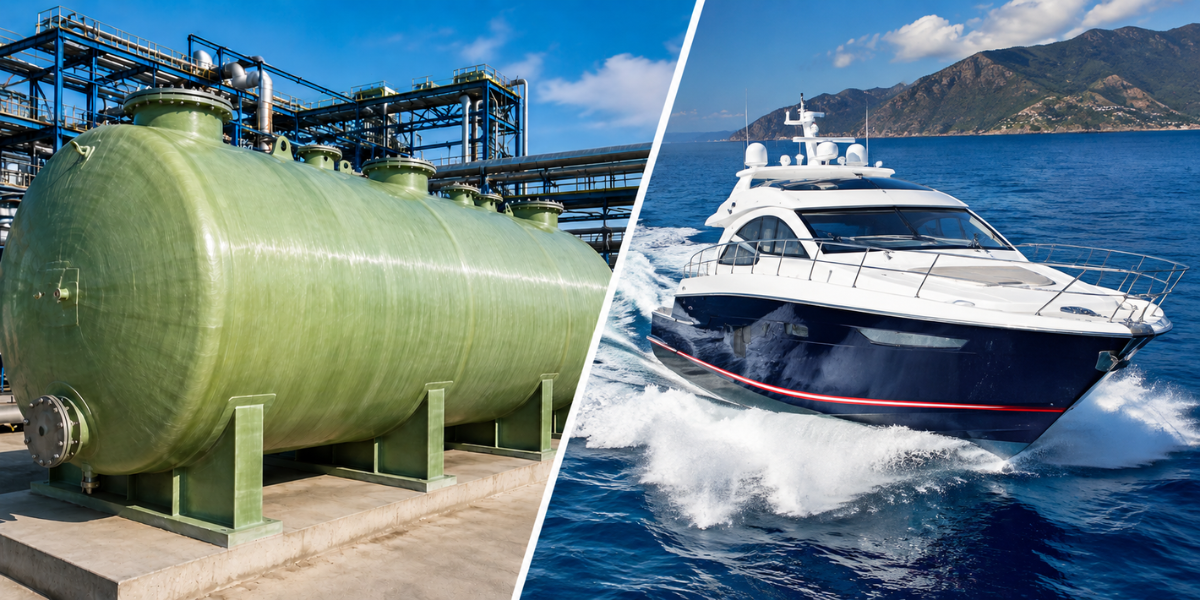
- Marine structures
- Industrial flooring
- Infrastructure components
- Filament-wound products
- Corrosion-resistant linings
Because these applications often operate continuously, reliable material performance becomes essential.
Vinyl Ester Resin for Corrosion Protection
Corrosion can quietly reduce the service life of industrial equipment. Traditional metal structures may require regular maintenance, protective coatings, or replacement when exposed to aggressive environments.
FRP offers an alternative because it does not rust like conventional steel. However, the resin system still needs to resist the surrounding environment.
That is where Vinyl Ester Resin can play a key role. It helps create a corrosion-resistant composite structure that can reduce maintenance requirements. Furthermore, FRP equipment can be lighter than many traditional alternatives, which may simplify transportation and installation.
Why Manufacturers Choose Vinyl Ester Resin?
Manufacturers need materials that perform consistently while also supporting efficient production. Vinyl Ester Resin can be used in several composite manufacturing processes, including hand lay-up, filament winding, pultrusion, and other FRP fabrication methods, depending on the formulation.
In addition, resin systems can be developed for different curing conditions and application requirements. This allows manufacturers to select a system based on factors such as processing time, curing temperature, mechanical performance, chemical exposure, and end-use requirements.
As a result, Vinyl Ester Resin is not simply a replacement for conventional polyester resin. Instead, it is a performance-oriented option for applications where durability matters more.
Choosing the Right Vinyl Ester Resin
- Not every FRP application has the same requirements. Temperature, chemical exposure, mechanical loads, fabrication method, and expected service life should all be considered before selecting a resin.
- For example, a chemical storage tank may require a different resin system from a marine component. Likewise, a filament-wound pipe may have different processing requirements from a hand-laminated FRP structure.
- Therefore, resin selection should be based on the complete application rather than price alone. Technical support and formulation expertise can also help manufacturers achieve better consistency and performance.
The Bottom Line
When FRP failure isn’t an option, material selection becomes a strategic decision. Vinyl Ester Resin offers a combination of chemical resistance, mechanical performance, toughness, and durability that makes it suitable for some of the most demanding composite applications.
From chemical processing equipment to marine structures and corrosion-resistant infrastructure, the right resin can significantly influence the life and reliability of an FRP product.
Ultimately, choosing Vinyl Ester Resin is about more than improving a formulation. It is about building FRP products that are designed to perform when the operating environment becomes challenging.
COMPANY INFO
Website: www.crestresins.com
Phone: +91 9879233188
Email: enquiry@crestresins.com
Address: 605/A, 6th Floor, Tower D, Times Square Grand Office, Sindhubhavan Marg, Near Taj Hotel, Ahmedabad, Gujarat - 380059
