
Discover why high heat resistant coating resin for appliances is essential for ovens and grills. Learn about heat stability, durability, surface protection, and performance.
Appliances such as ovens, grills, cookers, and other high-temperature equipment face intense heat during regular use. Their surfaces must remain durable, clean, and attractive even after repeated heating and cooling cycles. Therefore, the right coating system plays an important role in appliance performance.
This is where high heat resistant coating resin for appliances becomes important. These resin systems help coatings withstand elevated temperatures while protecting metal surfaces from heat-related damage, discoloration, and surface deterioration.
For applications such as ovens and grills, silicone epoxy resin can provide a strong foundation for coatings that need to perform under demanding thermal conditions.
What Is High Heat Resistant Coating Resin for Appliances?
High heat resistant coating resin for appliances is a specialized resin system designed for coating surfaces exposed to elevated temperatures. Unlike standard coating materials, these resins are developed to maintain their properties when appliances are repeatedly heated and cooled.
For example, oven interiors and grill components can experience significant temperature changes during operation. As a result, the coating must offer both thermal stability and good adhesion.
Silicone-modified epoxy resin systems can be used where a balance of heat resistance, adhesion, hardness, and surface protection is required.
Why Do Appliances Need High Heat Resistant Coatings?
Heat is not the only challenge faced by appliances. Repeated thermal cycling can also place stress on a coating. Over time, unsuitable coatings may crack, peel, lose gloss, or change appearance.
However, a properly selected high heat resistant coating resin for appliances can help reduce these problems.
Key benefits include:
- Better thermal stability: The coating can retain its performance when exposed to high temperatures.
- Improved surface protection: Metal surfaces are protected against environmental and operating conditions.
- Good adhesion: The coating stays attached to the substrate during repeated heating and cooling.
- Durability: A strong coating can extend the functional life of appliance components.
- Better appearance: The surface can maintain a consistent finish for longer.
- Resistance to thermal cycling: The coating is designed to handle repeated temperature changes.
Thus, resin selection is not simply a formulation decision. It can directly influence the reliability and appearance of the finished appliance.
High Heat Resistant Coatings for Appliances
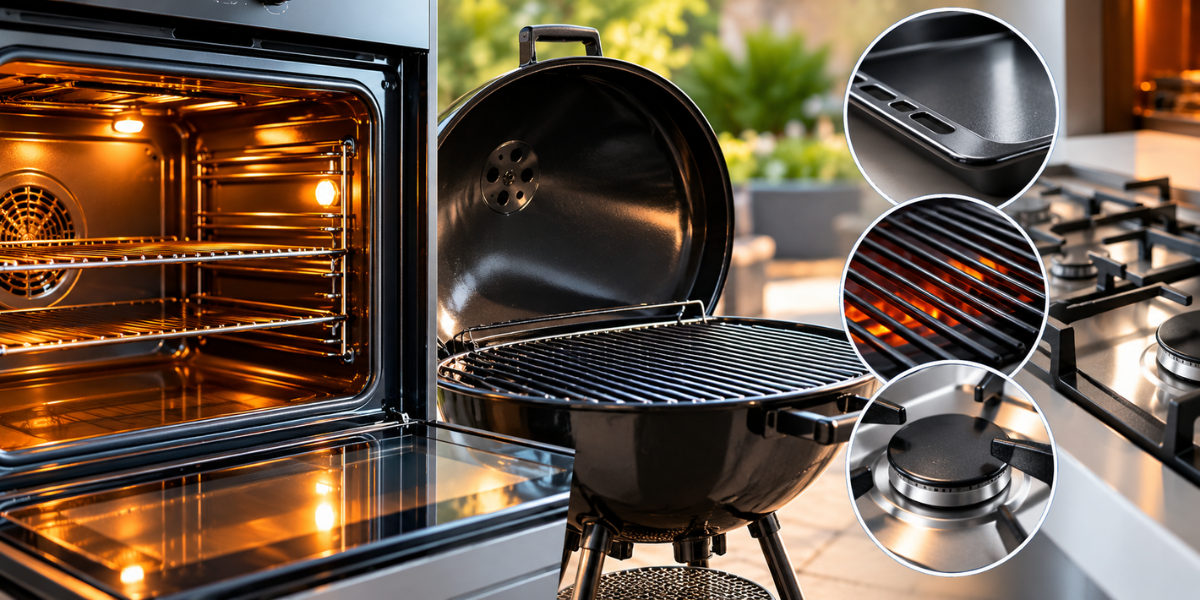
The need for thermal-resistant coatings extends across several appliance components.
Ovens
Ovens are exposed to high temperatures for extended periods. Therefore, their coated surfaces need strong thermal stability and adhesion. A suitable silicone epoxy resin system can support coatings designed for demanding oven applications.
Grills
Grills experience repeated heating, cooling, and exposure to cooking environments. Consequently, the coating must withstand thermal stress while maintaining surface integrity.
Cookers and Heating Equipment
Certain cooker components and heating equipment can also require coatings with improved temperature resistance. In such cases, the resin should be selected according to the operating temperature and substrate.
What Properties Should You Look For?
When selecting a high heat-resistant coating resin for appliances, several properties should be considered.
- Thermal resistance is one of the most important factors. The resin should be suitable for the expected operating temperature.
- Adhesion is equally important because repeated heating can create stress between the coating and metal substrate.
- Hardness and durability also matter. Appliance surfaces can face handling, cleaning, and mechanical contact. Therefore, the coating needs enough strength to withstand everyday use.
- Furthermore, chemical and moisture resistance may be valuable depending on the appliance and its operating environment.
Finally, application properties should not be overlooked. Good flow, curing behaviour, and compatibility with pigments or additives can help manufacturers achieve a consistent finish.
Choosing the Right Resin for Appliance Coatings
Every appliance application has different requirements. Temperature range, substrate type, coating thickness, curing conditions, and desired finish should all be evaluated before selecting a resin.
For this reason, manufacturers should work with a resin supplier that understands both coating chemistry and application requirements.
A silicone epoxy resin can be considered when the formulation requires a combination of epoxy-based performance and enhanced heat resistance. The final coating formulation, however, should always be evaluated under the actual application conditions.
Concluding Thoughts
Modern appliances need coatings that can perform beyond ordinary temperature conditions. Ovens, grills, and heating equipment are repeatedly exposed to heat, thermal cycling, cleaning, and everyday handling.
Therefore, high heat resistant coating resin for appliances is an important component in developing durable and reliable appliance coatings. With the right resin system, manufacturers can achieve better thermal stability, adhesion, durability, and surface protection.
For appliance coating applications, silicone epoxy resin offers a useful formulation platform where high-temperature performance and durable surface protection are required. Ultimately, choosing the right resin can help create coatings that are built to withstand the heat of everyday use.
COMPANY INFO
Website: www.crestresins.com
Phone: +91 9879233188
Email: enquiry@crestresins.com
Address: 605/A, 6th Floor, Tower D, Times Square Grand Office, Sindhubhavan Marg, Near Taj Hotel, Ahmedabad, Gujarat - 380059
