
Fiber-reinforced plastic (FRP) has become an important material for industries that need strength, durability, and corrosion resistance. However, the performance of an FRP product depends greatly on the resin used in its construction. This is where vinyl ester resin properties become highly valuable.
Vinyl ester resin combines several useful characteristics that support demanding FRP applications. It offers strong bonding, good chemical resistance, mechanical strength, and resistance to harsh environments. Therefore, it is widely considered for products such as tanks, pipes, scrubbers, gratings, marine structures, and industrial components.
Understanding Vinyl Ester Resin Properties in FRP
Vinyl ester resin is a thermosetting resin that is commonly reinforced with glass fibres to produce FRP components. Its molecular structure provides a useful balance between mechanical performance and chemical resistance.
Moreover, the resin can be formulated for different processing methods and application requirements. As a result, manufacturers can select suitable grades for specific operating conditions.
The following vinyl ester resin properties help explain its value in FRP manufacturing.
1. Excellent Chemical Resistance
Chemical exposure is a major concern in many industrial applications. FRP tanks, pipes, ducts, and scrubbers may encounter acids, alkalis, solvents, salts, and other aggressive substances.
Vinyl ester resin offers strong resistance to many corrosive environments. Therefore, it can help protect FRP structures from premature degradation when the correct resin grade is selected for the chemical service. This property is particularly useful in chemical processing, wastewater treatment, oil and gas, and power-generation applications.
2. Great Mechanical Strength
FRP components must withstand mechanical loads as well as environmental stress. Vinyl ester resin forms a strong matrix around reinforcing fibres such as glass fibre.
As a result, the finished composite can achieve a useful combination of tensile strength, stiffness, and impact resistance. This makes vinyl ester resin suitable for demanding structures where durability is important. Furthermore, the resin-fibre combination can be designed according to the required performance of the final component.
3. Strong Fiber Bonding
A resin does more than simply hold reinforcement in place. It transfers loads between the fibres and the surrounding matrix. Vinyl ester resin provides good adhesion with commonly used reinforcement materials. Consequently, effective fibre wet-out and bonding can contribute to consistent composite performance.
This is especially important in applications where FRP components experience continuous mechanical or environmental stress.
4. Resistance to Moisture and Harsh Environments
FRP products are often exposed to water, humidity, chemicals, and changing temperatures. Therefore, moisture resistance is another important consideration when selecting a resin.
Vinyl ester resin can provide good resistance to water and environmental exposure when the appropriate formulation and processing conditions are used. This makes it useful for marine structures, water-treatment equipment, storage tanks, and industrial piping.
5. Durability in Demanding Applications
One of the key advantages of vinyl ester resin properties is their contribution to long-term composite performance.
When the resin system, reinforcement, design, and manufacturing process are properly matched, FRP components can deliver reliable service under demanding conditions. Moreover, the material does not require the same level of maintenance as many traditional materials in certain corrosive applications.
However, actual service life depends on factors such as chemical concentration, temperature, loading, resin grade, laminate design, and manufacturing quality.
Why Do Vinyl Ester Resin Properties Matter for FRP?
The real value comes from how these properties work together. Chemical resistance helps protect against aggressive environments. Mechanical strength supports structural requirements. Good fibre bonding improves load transfer. Meanwhile, environmental resistance contributes to durability.
Therefore, selecting the right vinyl ester resin is not simply about choosing a high-performance material. It is about matching the resin system with the specific FRP application and operating environment.
Applications of Vinyl Ester Resin in FRP
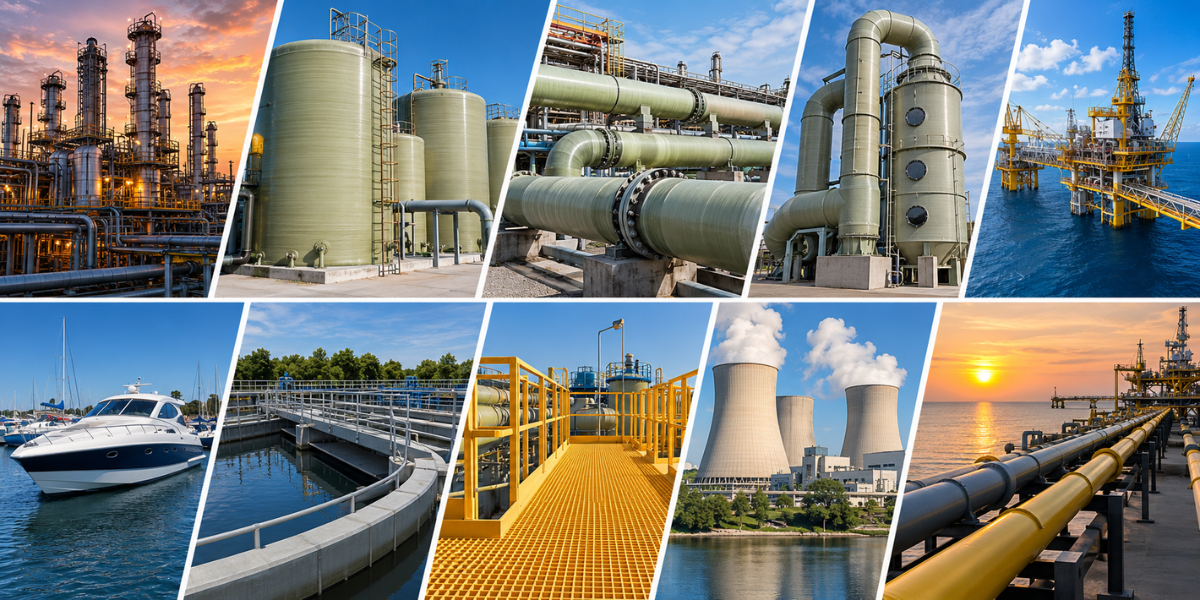
Because of these characteristics, vinyl ester resin is used across several industries, including:
- Chemical storage tanks
- FRP pipes and fittings
- Scrubbers and ducting
- Marine components
- Offshore structures
- Water and wastewater equipment
- Industrial gratings
- Power plant equipment
- Oil and gas infrastructure
- Corrosion-resistant process equipment
Choosing the Right Resin
Not every FRP application requires the same resin formulation. Therefore, buyers and manufacturers should consider chemical exposure, operating temperature, mechanical loads, processing method, curing conditions, and required service life.
A technically suitable resin can help manufacturers achieve the desired balance between performance, durability, and processing efficiency.
Concluding Thoughts
The value of vinyl ester resin properties lies in their ability to support demanding FRP applications. Chemical resistance, mechanical strength, fibre bonding, moisture resistance, and durability can work together to create reliable composite structures.
As industries continue to seek lightweight and corrosion-resistant materials, vinyl ester resin remains an important option for advanced FRP manufacturing. Ultimately, the right resin grade, reinforcement, laminate design, and manufacturing process must be selected according to the application’s specific requirements.
COMPANY INFO
Website: www.crestresins.com
Phone: +91 9879233188
Email: enquiry@crestresins.com
Address: 605/A, 6th Floor, Tower D, Times Square Grand Office, Sindhubhavan Marg, Near Taj Hotel, Ahmedabad, Gujarat - 380059
