
Discover the key benefits of composite resins across marine, automotive, construction, chemical, energy, and industrial applications.
Modern industries need materials that are strong, durable, lightweight, and reliable. At the same time, manufacturers must improve performance while controlling maintenance and production costs. Composite resins help meet these needs by providing a strong matrix for reinforced materials such as fiberglass composites.
Today, composite materials are used across many sectors. They support applications where traditional metals and other materials may face corrosion, weight, or durability challenges. As a result, composite resins have become an important part of modern industrial manufacturing.
What Are Composite Resins?
Composite resins act as the binding matrix in reinforced composite structures. They hold reinforcement materials, such as glass fibers, together and help transfer loads throughout the finished product.
Depending on the application, manufacturers can select different resin systems. Unsaturated polyester resin, vinyl ester resin, and other specialty resin systems can offer different levels of strength, chemical resistance, durability, and processing performance.n Therefore, the right resin selection can directly influence the service life and performance of a composite product.
Key Benefits of Composite Resins
1. Supports Lightweight Structures
One of the biggest benefits of composite resins is their ability to support lightweight composite structures with excellent mechanical performance.
When combined with suitable reinforcement, resin systems can produce strong components without adding excessive weight. Consequently, composites are widely used in transportation, marine, infrastructure, and industrial equipment. Lower weight can also make handling, installation, and transportation easier.
2. Excellent Corrosion Resistance
Industrial equipment often faces water, chemicals, moisture, and harsh environmental conditions. Metals can corrode when exposed to these conditions, especially without suitable protection.
Composite structures made with suitable resin systems can provide strong resistance to corrosion. Therefore, they are often used for FRP tanks, pipes, scrubbers, ducts, marine structures, and chemical-processing equipment. This benefit can reduce maintenance requirements and support longer service life.
3. Design Flexibility
Composite resins allow manufacturers to create products in different shapes, sizes, and configurations. Complex components can often be manufactured using processes such as hand lay-up, filament winding, pultrusion, compression moulding, and other composite manufacturing methods.
Moreover, resin systems can be developed for specific processing requirements. This flexibility helps manufacturers design products according to their application and production needs.
4. Strong Chemical Resistance
Chemical exposure is a major concern in industries such as chemical processing, wastewater treatment, oil and gas, and industrial manufacturing.
Suitable composite resin systems can provide resistance against a wide range of aggressive chemicals. As a result, composite materials can be used for tanks, pipelines, storage vessels, and process equipment where chemical durability is essential.
However, resin selection should always be based on the actual chemical environment, concentration, temperature, and service conditions.
5. Weather and Environmental Durability
Outdoor structures must withstand changing temperatures, moisture, sunlight, and other environmental conditions. Composite resin systems can be formulated to support long-term performance in demanding environments.
For example, composite materials are used in marine structures, infrastructure, outdoor equipment, and industrial applications. In addition, suitable surface protection can further improve durability.
6. Electrical and Thermal Performance
Certain composite resin systems offer useful electrical insulation properties. Therefore, they can be used in electrical and electronic components, cable-related applications, industrial equipment, and infrastructure.
Some specialty formulations can also provide improved thermal performance. Consequently, manufacturers can select resin systems based on the operating temperature and performance requirements of the final component.
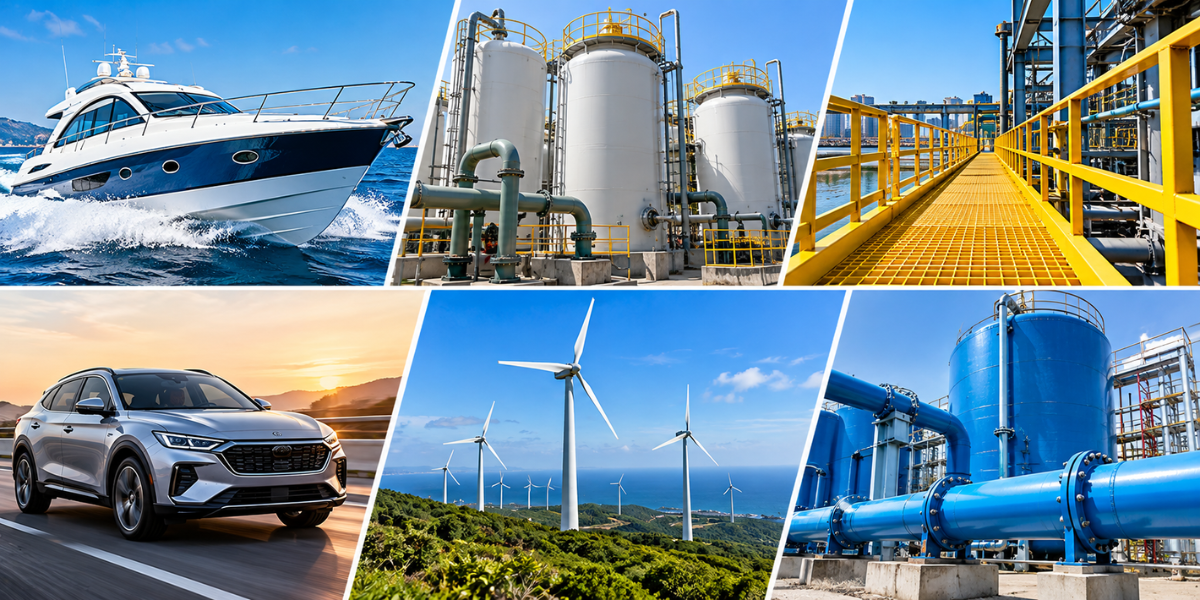
Composite Resins Across Industrial Applications
The versatility of composite resins makes them suitable for many industries.
- Marine: Boat hulls, decks, marine structures, and other components benefit from lightweight construction and corrosion resistance.
- Chemical Processing: FRP tanks, pipes, scrubbers, ducts, and process equipment can be manufactured for demanding chemical environments.
- Construction & Infrastructure: Composite gratings, structural components, panels, and reinforcement systems can provide durability with reduced weight.
- Automotive: Composite materials are used for selected vehicle components where weight reduction and design flexibility are important.
- Energy: Wind energy and other industrial applications use composites for components that require strength, durability, and controlled weight.
- Industrial Equipment: Covers, housings, ducts, tanks, and structural parts can benefit from the performance of engineered composite materials.
Choosing the Right Composite Resin
Not every resin system is suitable for every application. Therefore, manufacturers should consider mechanical strength, chemical exposure, operating temperature, curing requirements, processing method, and expected service life.
Additionally, reinforcement selection and manufacturing conditions can strongly affect final composite performance. Working with an experienced resin supplier can help manufacturers identify a suitable solution for their specific requirements.
Concluding Thoughts
Composite resins have become an important material solution across modern industries. Their combination of strength, lightweight performance, corrosion resistance, chemical durability, and design flexibility makes them suitable for a wide range of applications.
Furthermore, advances in resin technology continue to expand their potential. From marine structures and chemical tanks to automotive components and industrial infrastructure, composite resins help manufacturers develop products that are designed for performance and long-term use.
The right composite resin is not simply a raw material. It is a key part of building stronger, lighter, and more durable industrial solutions.
COMPANY INFO
Website: www.crestresins.com
Phone: +91 9879233188
Email: enquiry@crestresins.com
Address: 605/A, 6th Floor, Tower D, Times Square Grand Office, Sindhubhavan Marg, Near Taj Hotel, Ahmedabad, Gujarat - 380059
