
Discover how DMC compound supports electrical insulation, heat resistance, and precision moulding for reliable industrial and engineering components.
Introduction to DMC Compound
Electrical and industrial equipment needs components that can handle heat, provide insulation, and maintain their shape over time. At the same time, manufacturers want materials that support complex designs and consistent production. DMC compound helps meet these needs through a combination of resin, glass fibres, mineral fillers, and selected additives.
Dough Moulding Compound (DMC) is a ready-to-mould thermosetting composite material. It is widely used to manufacture electrical parts and other engineered components. Moreover, its formulation can be adjusted to meet different application requirements.
As industries demand reliable and efficient products, DMC compound continues to offer useful opportunities for manufacturers seeking dependable moulding solutions.
What Is DMC Compound?
DMC compound is a fibre-reinforced material designed for moulding under heat and pressure.
The final properties depend on the formulation and manufacturing process. Therefore, selecting the right DMC compound is essential for achieving the required performance in a finished component.
Key Benefits of DMC Compound
1. Reliable Electrical Insulation
- Electrical safety is essential in power distribution and industrial control systems. DMC compound can be formulated for electrical insulation applications, including selected switchgear components, terminal housings, and circuit breaker parts.
- Furthermore, the right formulation helps manufacturers meet application-specific electrical requirements. However, dielectric strength, tracking resistance, and other properties must be verified against the relevant specifications.
2. Heat and Dimensional Stability
- Components often face temperature changes during regular operation. Suitable DMC compound grades can retain their shape and performance under defined thermal conditions.
- As a result, they can support applications where dimensional consistency matters. However, actual heat resistance depends on the resin system, formulation, curing conditions, and service environment.
3. Complex Moulding Capabilities
- Modern components often require detailed shapes and integrated design features. DMC compound can be compression moulded into complex forms, including parts with ribs, mounting points, and intricate profiles.
- Consequently, manufacturers may be able to combine several features into one component. This can simplify assembly and support repeatable production when the moulding process is properly controlled.
Where Is DMC Compound Used?
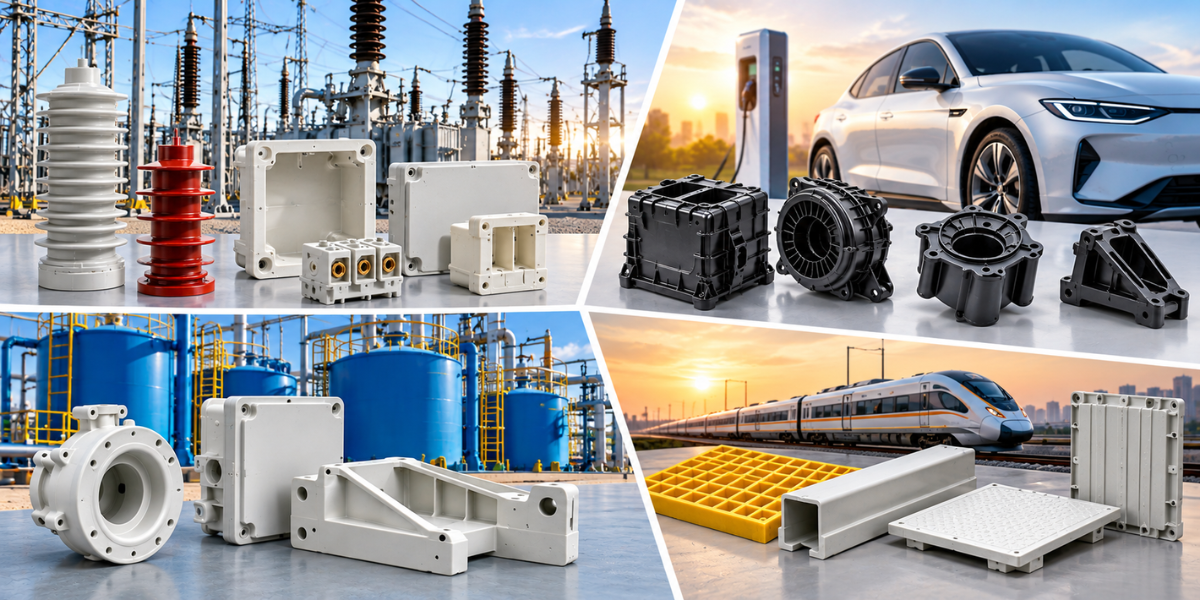
Electrical and Power Equipment
Electrical applications are a major area for DMC compound. Depending on the grade, it can be used for switchgear housings, insulating supports, circuit breaker components, and other electrical parts. These applications require careful material selection because electrical, thermal, and mechanical performance must work together.
Automotive Applications
Automotive manufacturers need materials that combine durability with design flexibility. Suitable DMC compound grades may be used in selected electrical housings, lighting components, and other moulded parts. Moreover, the ability to create complex shapes can support compact designs and efficient assembly.
Industrial Equipment
Industrial machinery uses many components that require consistent dimensions and dependable performance. DMC compound can support selected housings, covers, and engineered parts, depending on the operating conditions. Therefore, manufacturers should assess temperature exposure, mechanical loads, and environmental requirements before selecting a grade.
How DMC Compound Supports Efficient Production?
DMC compound is designed for moulding processes that use heat and pressure. During curing, the thermosetting resin forms a cross-linked structure, creating a rigid finished component.
This process supports repeatable production and detailed component designs. In addition, suitable process control can help reduce defects and improve material utilisation.
However, manufacturers must manage mould temperature, pressure, curing time, and material handling carefully. These factors influence the quality and consistency of the finished part.
Choosing the Right DMC Compound Manufacturer
Choosing a DMC compound manufacturer involves more than reviewing product specifications. Buyers should consider formulation consistency, technical support, processing requirements, and suitability for the intended application.
A reliable supplier can help manufacturers identify the right material properties and address processing challenges. Furthermore, close technical collaboration can support product development and long-term manufacturing performance.
Concluding Thoughts
DMC compound offers a useful combination of moulding flexibility, mechanical strength, and potential electrical insulation performance. These features make it suitable for a range of electrical, automotive, and industrial applications.
As component designs become more demanding, the right formulation and controlled processing will remain essential. By selecting suitable materials and working with an experienced supplier, manufacturers can develop reliable, moulded components that meet their specific needs.
COMPANY INFO
Website: www.crestresins.com
Phone: +91 9879233188
Email: enquiry@crestresins.com
Address: 605/A, 6th Floor, Tower D, Times Square Grand Office, Sindhubhavan Marg, Near Taj Hotel, Ahmedabad, Gujarat - 380059
