Discover how UV Curable Resins are transforming the coatings industry with faster curing, lower energy use, reduced emissions, and high-performance finishes.
The coatings industry is changing quickly. Manufacturers now need coatings that cure faster, reduce energy use, and meet stricter environmental requirements. At the same time, customers expect excellent surface quality and long-lasting performance. UV Curable Resins are helping the industry meet these demands.
Unlike conventional coating systems that may need heat or long drying periods, UV curable systems use ultraviolet light to trigger a rapid chemical reaction. As a result, the coating can develop its final properties within seconds. This combination of speed, efficiency, and performance is changing how many coating processes are designed.
What Makes UV Curable Resins Different?
UV Curable Resins are specially formulated materials that cure when exposed to ultraviolet radiation. This process offers an important advantage; curing can happen almost immediately after application. Therefore, coated components can often move to the next production stage much faster.
Moreover, UV curing allows manufacturers to control the process with greater precision. The curing response can be adjusted through resin chemistry, formulation, UV intensity, and exposure time.
UV Curable Resins Deliver Faster Production
- Production speed is a major concern for modern manufacturers. Traditional coatings may require significant drying or oven time before the coated surface can be handled. This can create production bottlenecks.
- In contrast, UV Curable Resins can cure within a very short exposure period when the formulation and process conditions are suitable. Consequently, manufacturers can reduce waiting time between coating and handling.
- Faster curing can also support automated production lines. Parts can move continuously through application and curing stages rather than waiting for lengthy drying cycles. This makes UV technology particularly useful where production efficiency is a priority.
UV Curable Resins Can Reduce Energy Consumption
- Energy efficiency has become another important factor in coating operations. Conventional thermal curing often relies on ovens that must reach and maintain high temperatures.
- UV curing works differently. Instead of heating the entire coated component, UV radiation activates the curing reaction directly within the coating. Therefore, the process can require less energy than some thermal curing methods.
- However, actual energy savings depend on the coating formulation, equipment, line speed, substrate, and operating conditions. Even so, the ability to cure without prolonged high-temperature heating makes UV Curable Resins an attractive option for energy-conscious manufacturers.
Supports High-Quality Finishes
- Speed alone does not make a coating successful. Surface appearance and performance are equally important. UV Curable Resins can be formulated to provide properties such as good hardness, scratch resistance, chemical resistance, gloss, and surface appearance. As a result, they can be used in applications where both aesthetics and durability matter.
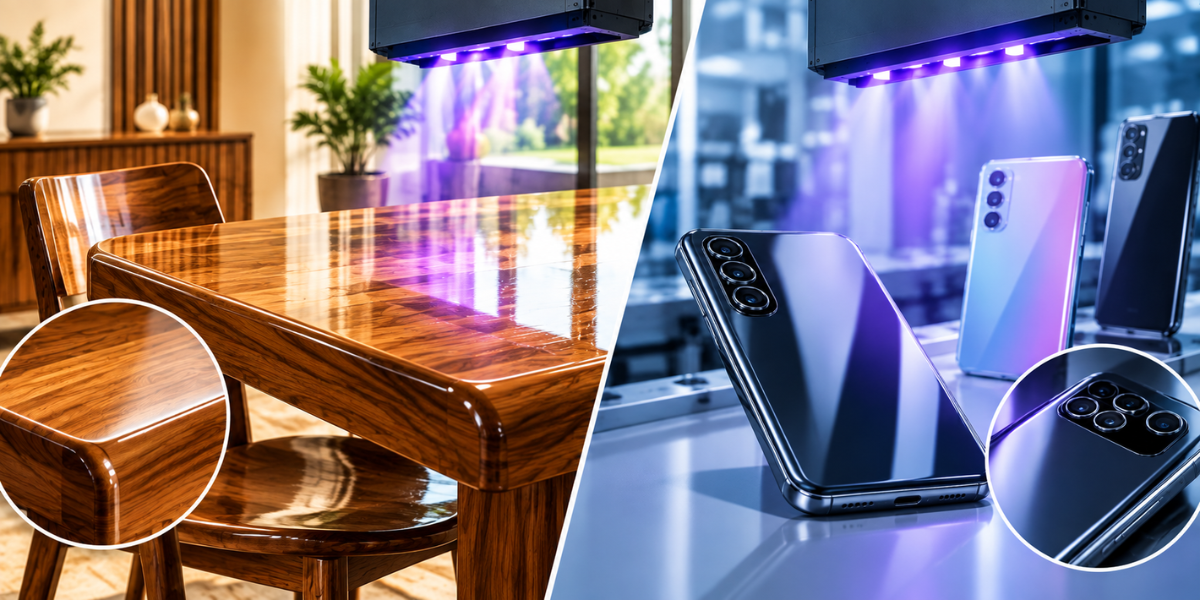
- For example, UV curable coatings are used in areas such as wood finishing, furniture, flooring, plastics, electronics, and specialty industrial coatings. Depending on the formulation, the resin system can be designed to meet different performance requirements.
Lower VOC Potential
- Environmental considerations are also influencing coating technology. Solvent-based systems can release volatile organic compounds (VOCs) during application and drying.
- Many UV-curable coating systems can be formulated with high solids or low solvent content. Therefore, they can help manufacturers reduce VOC emissions compared with certain conventional coating technologies.
- Nevertheless, environmental performance should always be evaluated at the complete formulation and process level. Resin chemistry, reactive diluent, additives, application method, and curing conditions all affect the result.
Where Are UV Curable Resins Being Used?
The versatility of UV Curable Resins is one reason their use continues to expand.
Common application areas include:
- Wood and furniture coatings
- Flooring and decorative surfaces
- Plastic coatings
- Electronics and electrical components
Furthermore, advances in resin chemistry are creating opportunities for new substrates and more demanding applications.
The Future of UV Curable Resins
The coatings industry is moving toward processes that combine productivity, performance, and resource efficiency. UV Curable Resins fit well within this direction because they offer rapid curing while supporting modern manufacturing requirements. Manufacturers are also looking for coating systems that deliver better performance with lower environmental impact.
Therefore, UV curing is not simply about making coatings dry faster. It represents a broader shift toward smarter and more efficient coating processes.
Concluding Thoughts
UV Curable Resins are transforming the coatings industry by bringing together rapid curing, production efficiency, surface performance, and the potential for reduced energy use and VOC emissions. Although the right formulation depends on the application, their advantages make them an increasingly important technology for modern coating manufacturers.
As coating requirements continue to evolve, UV technology is likely to play an even greater role in creating faster, more efficient, and high-performance coating solutions.
COMPANY INFO
Website: www.crestresins.com
Phone: +91 9879233188
Email: enquiry@crestresins.com
Address: 605/A, 6th Floor, Tower D, Times Square Grand Office, Sindhubhavan Marg, Near Taj Hotel, Ahmedabad, Gujarat - 380059
