
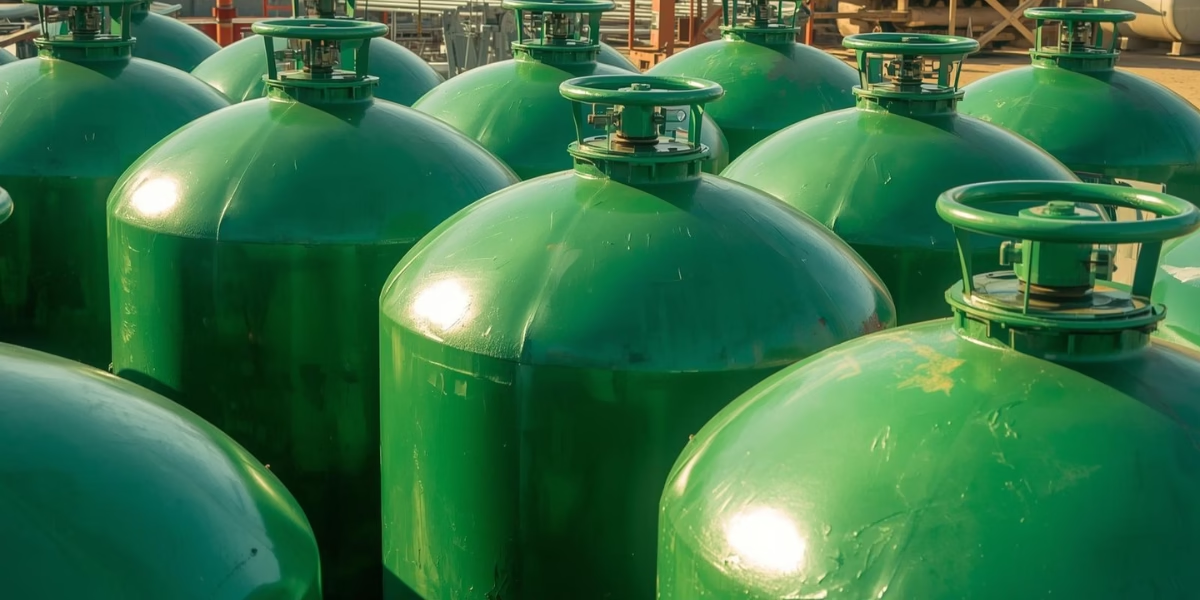
Discover how Filament Winding Resin Technology creates strong, lightweight pressure vessels with high durability, corrosion resistance, and long-term performance.
Pressure vessels must handle harsh conditions every day. They face high internal pressure, temperature swings, and demanding industrial environments. Because of these challenges, manufacturers need materials that deliver strength, reliability, and safety. This is exactly where Filament Winding Resin Technology plays an essential role. It helps build lightweight composite vessels that outperform traditional metal tanks in durability and efficiency. This blog explains how the technology works and why it is becoming the preferred choice for modern industries.
Understanding Filament Winding Resin Technology
Filament winding is a controlled manufacturing process that uses continuous fibers and a resin system to create cylindrical or spherical composite structures. The fibers are usually glass, carbon, or aramid, are wound over a rotating mandrel. As they wind, the fibers are impregnated with a specially formulated resin. This resin-fiber combination forms a strong, lightweight composite layer.
The resin system is the backbone of the process. It binds the fibers, protects them, and ensures long-term stability. Because the resin determines the vessel’s performance, Filament Winding Resin Technology focuses on developing strong, chemical-resistant, and durable resin formulations.
Why Industries Rely on Filament Winding Resin Technology?
Traditional steel pressure vessels are heavy and prone to corrosion. They also require frequent maintenance. Composite vessels made with filament winding overcome these issues. They offer high strength, low weight, and excellent corrosion resistance.
Furthermore, they are safer. Composite structures dissipate stress more effectively and resist cracking. As a result, industries gain longer service life with fewer failures.
Advantages of Filament Winding Resin Technology
Several advantages make this technology ideal for high-pressure applications.
Filament Winding Resin Offers High Strength-to-Weight Ratio
Composite pressure vessels can be up to 70% lighter than steel alternatives. However, they maintain exceptional strength. The resin binds the fibers and distributes stress evenly. Therefore, the vessel handles high internal pressure without deformation.
Superior Corrosion Resistance
Metal tanks corrode when exposed to moisture, chemicals, or harsh environments. Composite vessels do not rust. The resin layer blocks corrosive substances, which helps maintain structural integrity over years of use.
Long-Term Durability with Filament Winding Resin Technology
The resin system improves fatigue resistance. It also protects the fibers from UV radiation, moisture, and heat. Consequently, the vessel maintains its performance throughout its lifespan, even in extreme conditions.
Outstanding Chemical Stability
Industries often store aggressive substances such as acids, fuels, and industrial chemicals. Filament winding resins can be engineered for specific chemical environments, offering reliable protection and preventing premature failure.
Efficient and Consistent Manufacturing
Filament winding is precise. It places fibers at exact angles and ensures uniform resin distribution. This makes production more consistent and reduces the chances of defects. Because of this, manufacturers achieve faster output and higher quality.
Resins Commonly Used in Filament Winding Resin Technology
The type of resin determines the final characteristics of the pressure vessel. Therefore, manufacturers choose from several resin systems.
Epoxy Resin
Epoxy resin is widely used because it offers strong bonding, high strength, and excellent fatigue resistance.
Applications:
- CNG cylinders
- Hydrogen storage vessels
- Aerospace components
Vinyl Ester Resin
Vinyl ester resin provides strong chemical resistance and good mechanical strength. It is ideal for harsh industrial environments.
Applications:
- Chemical tanks
- Marine piping
- Corrosion-resistant vessels
Polyester Resin
Polyester resin is economical and easy to process. Although it has lower strength than epoxy or vinyl ester, it works well in low to moderate pressure applications.
Applications:
- Water tanks
- Low-pressure pipelines
- General FRP products
Where Is Filament Winding Resin Technology Used Practically?
The demand for composite pressure vessels is growing across several sectors.
Gas Storage and Distribution
Filament winding technology is used to manufacture cylinders for CNG, LPG, hydrogen, and oxygen. These cylinders are lighter, safer, and easier to transport.
Chemical and Industrial Processing
Composite vessels hold acids, solvents, and corrosive liquids. The resin structure prevents degradation and ensures long service life.
Water Treatment and Infrastructure
Water storage tanks, filtration vessels, and pipelines made with composite materials resist rust and remain durable for years.
Marine and Offshore Industries
The marine environment causes rapid corrosion in metal vessels. Composite tanks made using Filament Winding Resin Technology withstand saltwater and moisture, improving performance.
Aerospace and Defense
Lightweight materials are critical in aerospace applications. Composite pressure vessels reduce weight without sacrificing strength, improving efficiency and safety.
How Filament Winding Resin Technology Builds Stronger Vessels?
The secret lies in the interaction between fibers and resin. Fibers carry tensile loads, while the resin holds them in place and distributes stress. As layers build up, the vessel becomes extremely strong. After curing, the composite structure gains rigidity and stability. This allows it to handle high pressure even in demanding environments. The resin also prevents environmental damage, ensuring long-term durability.
Final Thoughts
Filament Winding Resin Technology has reshaped the future of pressure vessel manufacturing. It offers unmatched strength, reduced weight, and superior corrosion resistance. As industries continue to demand safer and more efficient storage solutions, composite pressure vessels will keep gaining importance. With the right resin system, manufacturers can achieve long-lasting performance and improved safety across multiple applications.
COMPANY INFO
Website: www.crestresins.com
Phone: +91 9879233188
Email: enquiry@crestresins.com
Address: 605/A, 6th Floor, Tower D, Times Square Grand Office, Sindhubhavan Marg, Near Taj Hotel, Ahmedabad, Gujarat - 380059
