
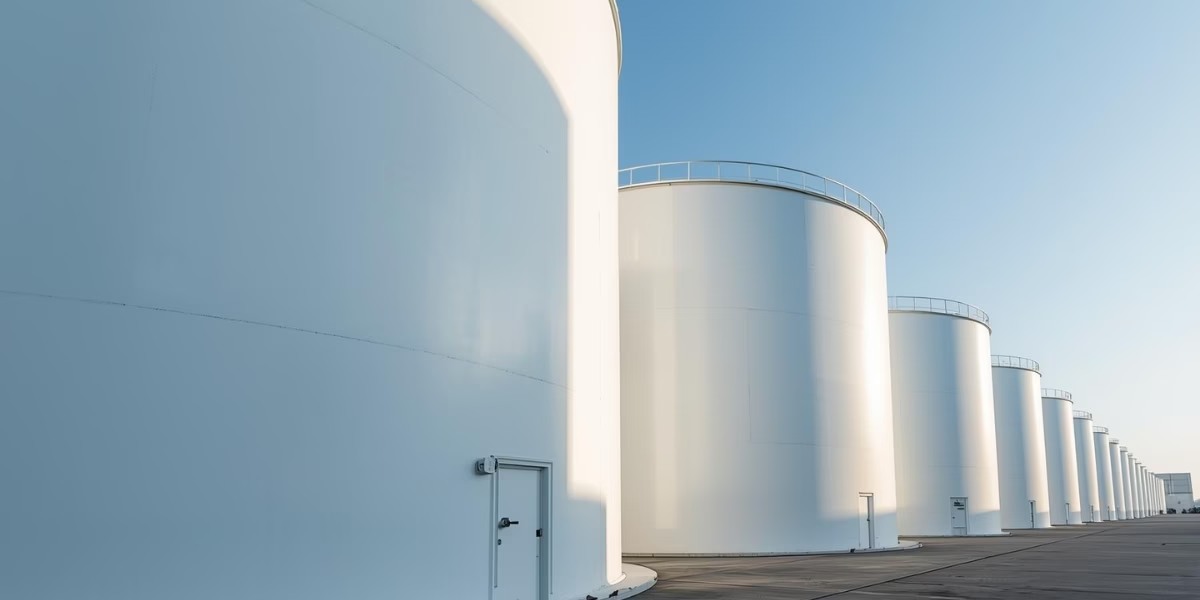
Explore the future of composites through filament winding resin technology. Learn how it is transforming industrial infrastructure with strength, durability, and efficiency.
Industrial infrastructure is evolving fast. Pipes must handle pressure. Tanks must resist corrosion. Structural components must last for decades. Traditional materials often fall short. However, composites are changing the game.
At the center of this shift lies filament winding resin technology. It combines advanced resins with precision manufacturing. As a result, infrastructure becomes lighter, stronger, and more reliable.
Understanding Filament Winding Resin Technology
Filament winding resin technology is a composite manufacturing process. Continuous fibers are impregnated with resin and wound onto a rotating mandrel in controlled patterns. The resin is then cured to form a solid structure.
Because fiber placement is precise, strength is built exactly where it is needed. Therefore, material efficiency improves. Waste is reduced. Performance increases.
This technology is widely used for pressure vessels, pipes, tanks, and structural components.
Why Infrastructure Demands Filament Winding Resin Technology?
Modern infrastructure faces extreme conditions. High pressure, corrosive chemicals, temperature changes, and mechanical stress are common. Steel and concrete degrade over time. Maintenance costs rise.
In contrast, composites produced using filament winding resin technology offer excellent corrosion resistance and high strength-to-weight ratios. Consequently, service life is extended, and operational reliability improves.
The Role of Resin in Filament Winding Performance
Resin selection defines performance. In filament winding resin technology, resins do more than bind fibers. They protect, reinforce, and stabilize the structure.
Thermoset resins such as epoxy, vinyl ester, and polyester are commonly used. Each provides specific benefits. Epoxy delivers high mechanical strength. Vinyl ester offers superior chemical resistance. Polyester supports cost-effective production.
Because the resin fully wets the fibers, load transfer is optimized. As a result, structural integrity is enhanced.
Strength Where It Matters Most
One key advantage of filament winding resin technology is directional strength. Fibers are aligned along load paths. This design approach increases pressure resistance and fatigue life.
For example, composite pipes handle internal pressure more efficiently than isotropic materials. Similarly, storage tanks resist cracking and leakage. Therefore, infrastructure systems perform safely for longer periods.
Lightweight Structures, Heavy-Duty Performance
Weight reduction is critical in industrial infrastructure. Lighter components are easier to transport and install. Foundations can be smaller. Energy consumption drops.
Thanks to filament winding resin technology, composite structures deliver high strength with significantly less weight. This balance supports both performance and efficiency.
Consistency Through Automation in Filament Winding Resin Technology
Infrastructure projects demand consistency. Manual processes introduce variation. However, filament winding is highly automated.
In filament winding resin technology, winding angles, resin content, and curing conditions are controlled precisely. Because of this, product quality remains consistent across large production volumes. Reliability is improved, and failure risks are reduced.
Expanding Applications in Industrial Infrastructure
The impact of filament winding resin technology is growing across sectors, including:
- Chemical storage tanks and vessels
- Oil and gas pipelines
- Water and wastewater infrastructure
- Pressure cylinders for energy systems
- Structural reinforcements and poles
As infrastructure requirements increase, composite solutions continue to replace traditional materials.
Sustainability and Long-Term Value
Durability supports sustainability. Longer-lasting infrastructure means fewer replacements. As a result, resource consumption decreases.
Additionally, filament winding resin technology enables optimized material use. Fibers and resins are placed only where required. This reduces waste. Over time, lifecycle costs are lowered, and environmental impact is minimized.
The Future Outlook for Filament Wound Composites
Innovation continues to push boundaries. Advanced resin chemistries, faster curing systems, and digital process control are improving productivity. Smart design tools further enhance performance.
Because of these advances, filament winding resin technology will play a vital role in future infrastructure development. From energy to water management, its influence will only expand.
Concluding Thoughts
Industrial infrastructure must be strong, durable, and efficient. Traditional materials alone cannot meet these demands. Filament winding resin technology offers a smarter alternative.
By combining precision fiber placement with high-performance resins, it delivers structures that last longer and perform better. As industries look ahead, this technology will remain a cornerstone of the future of composites and infrastructure.
COMPANY INFO
Website: www.crestresins.com
Phone: +91 9879233188
Email: enquiry@crestresins.com
Address: 605/A, 6th Floor, Tower D, Times Square Grand Office, Sindhubhavan Marg, Near Taj Hotel, Ahmedabad, Gujarat - 380059
