
How does automotive putty resin support better vehicle refinishing? Explore its role in filling dents, enhancing surface uniformity, and delivering a professional finish for automotive body repairs.
The Role of Automotive Putty Resin
A smooth vehicle surface is more than a visual feature. It also reflects the quality of the repair and coating process. However, dents, scratches, minor surface defects, and uneven metal panels can affect the final finish. Therefore, automotive putty plays an important role in vehicle manufacturing and refinishing.
Behind this material is a key ingredient, automotive putty resin. It helps bind the formulation, supports adhesion, and contributes to the strength and finish of the applied putty. As automotive manufacturers and repair professionals seek reliable results, choosing the right resin becomes increasingly important.
What Is Automotive Putty Resin?
Automotive putty resin is a polymer binder used to formulate putties for filling small dents, surface irregularities, and imperfections. It helps hold the filler materials together and supports the formation of a workable, uniform layer.
Unsaturated polyester resin (UPR) is widely used in many automotive body fillers because it offers useful processing and performance characteristics. When combined with suitable fillers, additives, and a curing system, it can form a hard surface that can be sanded and prepared for subsequent coating. However, the final performance depends on the complete formulation, curing conditions, substrate, and intended application.
Why Does the Industry Need Automotive Putty Resin?
1. To Achieve a Smooth Surface
Surface preparation is essential before applying primer and paint. Even small dents or uneven areas can become visible under a glossy topcoat. Automotive putty helps fill these imperfections and create a more even surface.
As a result, the subsequent coating can deliver a cleaner appearance. Moreover, a well-formulated putty can reduce surface irregularities that might otherwise affect the final finish.
2. To Support Adhesion and Repair Quality
A repair material must bond well to the intended substrate. Automotive putty resin contributes to the binder system that holds the formulation together and supports adhesion.
However, good adhesion does not depend on resin alone. Surface cleaning, sanding, correct mixing, and suitable application methods are also important. Therefore, manufacturers must select a resin that works well with the chosen fillers and other formulation ingredients.
3. To Improve Sanding Performance
After curing, automotive putty is often sanded to achieve the required surface profile. The material should be hard enough to maintain its shape, yet workable enough to allow efficient sanding.
Consequently, resin selection can influence the balance between hardness, sanding behaviour, and surface quality. A suitable formulation helps repair professionals prepare the surface for primer and paint without unnecessary effort.
4. To Support Efficient Repair Work
Time matters in automotive workshops and body shops. Materials that are easy to mix, apply, cure, and sand can help improve workflow.
For this reason, automotive putty formulations are developed to meet specific working-time and curing requirements. Nevertheless, curing speed must be balanced with application conditions and the required finish. Faster curing is not automatically better if it reduces working time or affects application quality.
5. To Deliver Consistent Results
Automotive repair professionals need materials that perform reliably across repeated applications. Variations in viscosity, curing behaviour, hardness, or sanding characteristics can affect productivity and finish quality.
Therefore, consistent automotive putty resin quality is important for manufacturers. Reliable raw materials and controlled formulation practices help support repeatable results across production batches.
Key Properties to Consider When Selecting Automotive Putty Resin
The right resin should match the intended putty formulation and application. Manufacturers should evaluate several important factors:
- Viscosity: Supports mixing, filler incorporation, and application.
- Adhesion: Helps the formulated putty bond to suitable prepared substrates.
- Curing behaviour: Influences working time and readiness for sanding.
- Hardness: Supports the cured layer and its ability to retain shape.
- Sanding performance: Affects surface preparation and finishing efficiency.
- Compatibility: Helps ensure suitable interaction with fillers, additives, pigments, and curing agents.
In addition, manufacturers should assess storage stability and performance under the intended processing conditions. Testing the complete formulation is essential because resin properties alone cannot predict every application result.
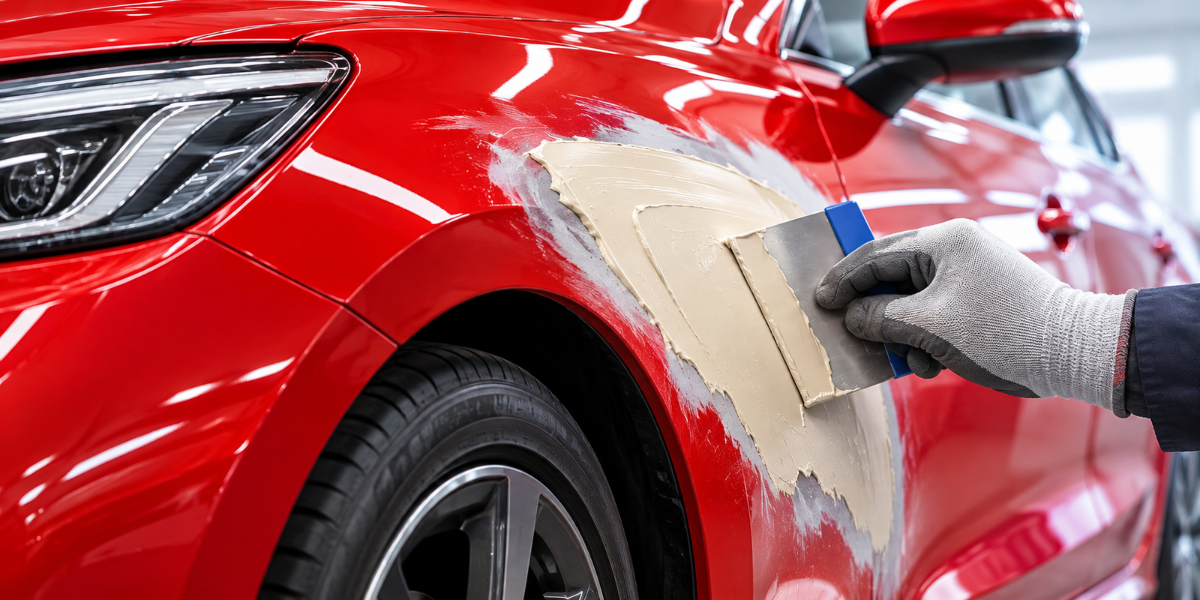
The Role of Automotive Putty Resin in Modern Vehicle Refinishing
Automotive finishes continue to evolve as vehicle designs, coating systems, and repair expectations change. Meanwhile, body shops need materials that support efficient repairs and high-quality finishes.
Automotive putty resin helps meet these requirements by serving as a key component of surface-filling formulations. Furthermore, collaboration between resin manufacturers and putty formulators can support improvements in application behaviour, curing, and sanding performance.
As a result, selecting a resin based on technical requirements rather than price alone can help manufacturers achieve more consistent outcomes.
Conclusion
Automotive putty resin is an important part of the automotive surface preparation process. It supports the binder system, contributes to adhesion and cured properties, and helps create surfaces ready for subsequent coating.
However, the best results come from the right combination of resin, fillers, additives, curing system, and application practices. By focusing on technical performance and formulation compatibility, automotive putty manufacturers can develop products that meet the needs of modern vehicle repair and refinishing.
COMPANY INFO
Website: www.crestresins.com
Phone: +91 9879233188
Email: enquiry@crestresins.com
Address: 605/A, 6th Floor, Tower D, Times Square Grand Office, Sindhubhavan Marg, Near Taj Hotel, Ahmedabad, Gujarat - 380059
